PACIFIC BUILT, ATLANTIC BOUND
Separated from the U-boat threat by 5,000 kilometers of land, British Columbia’s shipyards mobilized to become the Allies' vital lifeline. While the Atlantic burned, the Pacific forged the steel to extinguish it. This timeline traces the odyssey of the West Coast war effort—from the rivets driven in North Vancouver and Esquimalt to the desperate convoy battles of the North Atlantic.
Moribund Industry Mobilizes
Before 1939, Canada's shipbuilding industry had been moribund for nearly two decades [1-4]. The total labour force in 1939 was only about 3,796 employees [5]. The industry's revival began with the urgent demand for ships to support the Allied lifeline across the Atlantic [6].
Image Source: Unemployed Parade Through Vancouver, 1935

The Longest Battle Commences
The Battle of the Atlantic began on the opening day of the Second World War On September 3 1939, just hours after Britain entered into a state of war [1, 2]. The sinking of the British liner Athenia, destined for Canada, by a German submarine west of Ireland marked the commencement of the longest battle of the war, The first Allied casualties, and the first criminal act of war.
Image Source: RCI Radio Canada International

BC Mobilizes as "Unsinkable Arsenal"
The cargo ship program "unleashed a wave of private investment" in British Columbia [11]. BC provided a secure industrial base for uninterrupted production due to its mild climate and geographic isolation from the U-boat threat [12, 13].
Image Source: MONOVA Museum & Archives of North Vancouver

The Crisis of the "Black Pit"
U-boat attacks reached their peak effectiveness in the mid-Atlantic air gap, known as the "Black Pit," where Allied aircraft could not reach. Allied losses mounted to critical levels, threatening the entire war effort and making the rapid production of Canadian corvettes and cargo ships a matter of survival[ 9, 16].
Image Source: WIKIPEDIA The Free Encyclopedia

Terror in the St. Lawrence
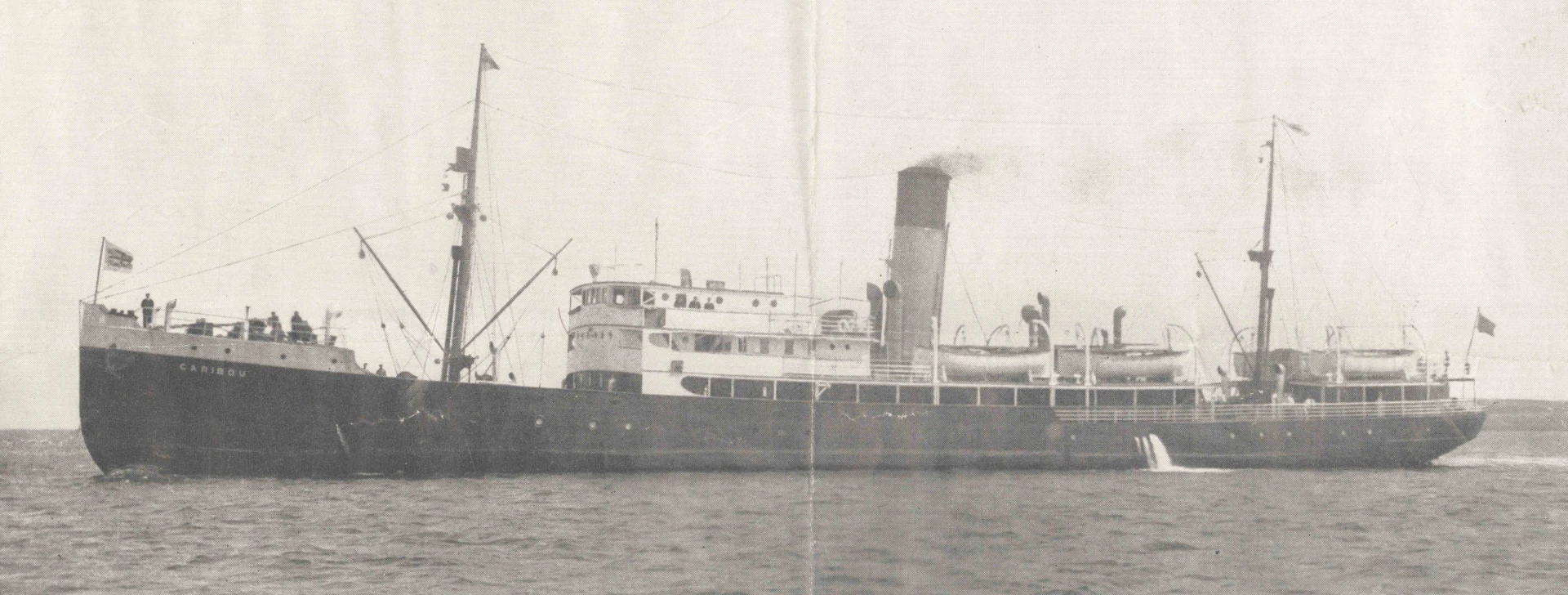
The war came to Canada's doorstep when the ferry SS Caribou was sunk by a U-boat in the St. Lawrence, resulting in the loss of 136 men, women, and children [11]. This tragedy galvanized the home front.
Image Source: TRIDENT The Newspaper of Maritime Forces Atlantic Since 1966
"Black May": The Turning of the Tide
May 1943 also had the greatest monthly losses suffered by U-boats up to that time, with 34 being destroyed.[3] On 24 May 1943, Admiral Dönitz, shocked at the defeat suffered by the U-boats, ordered a temporary halt to the U-boat campaign; most were withdrawn from operational service. The U-boats were unable to return in significant numbers until autumn and never regained the advantage.[10]
Image Source: WIKIPEDIA The Free Encyclopedia

Arsenal Reaches Peak Capacity
The high point for shipyard business and employment in British Columbia occurred in late July 1943 [12]. Nationally, Canada contributed to escorting nearly half of all Atlantic convoys [13] and produced 122 Flower-class corvettes [14].
Image Source: BRITISH COLUMBIA - An Untold History
HMCS Waskesiu Sinks U-257
The River-class frigate HMCS Waskesiu (K330), the first frigate completed on the West Coast, sank U-257 in the Atlantic [15]. This victory validated the capability of West Coast shipyards to build sophisticated anti-submarine vessels needed to counter advanced U-boats.
Image Source: For Posterity's Sake - A Royal Canadian Navy Historical Project

D-Day / Operation Neptune
Canadian forces played an extensive role in the naval phase of the Normandy landings [8]. The Battle of the Atlantic battle honour was earned by vessels like the HMCS Alberni during this critical period [7].
Image Source: WIKIPEDIA The Free Encyclopedia

HMCS Alberni Sunk
On 21 August 1944, while performing an anti-submarine patrol east of the D-day landing site, Alberni was torpedoed and sunk by the German submarine U-480. The ship sank quickly and 59 sailors were killed, with the remaining crew being rescued by Royal Navy motor torpedo boats. A maritime museum in Courtenay, British Columbia now honours the name of the ship and its dead. [7]
Image Source: CFB ESQUIMALT - Naval Military Museum

V-E Day and Conclusion
V-E Day marked the end of the Second World War in Europe and the conclusion of the Battle of the Atlantic [1, 2]. By 1945, the RCN had grown to nearly 400 fighting ships [10], many of which were built in Canadian yards.
Image Source: MONOVA - Museum & Archives of North Vancouver

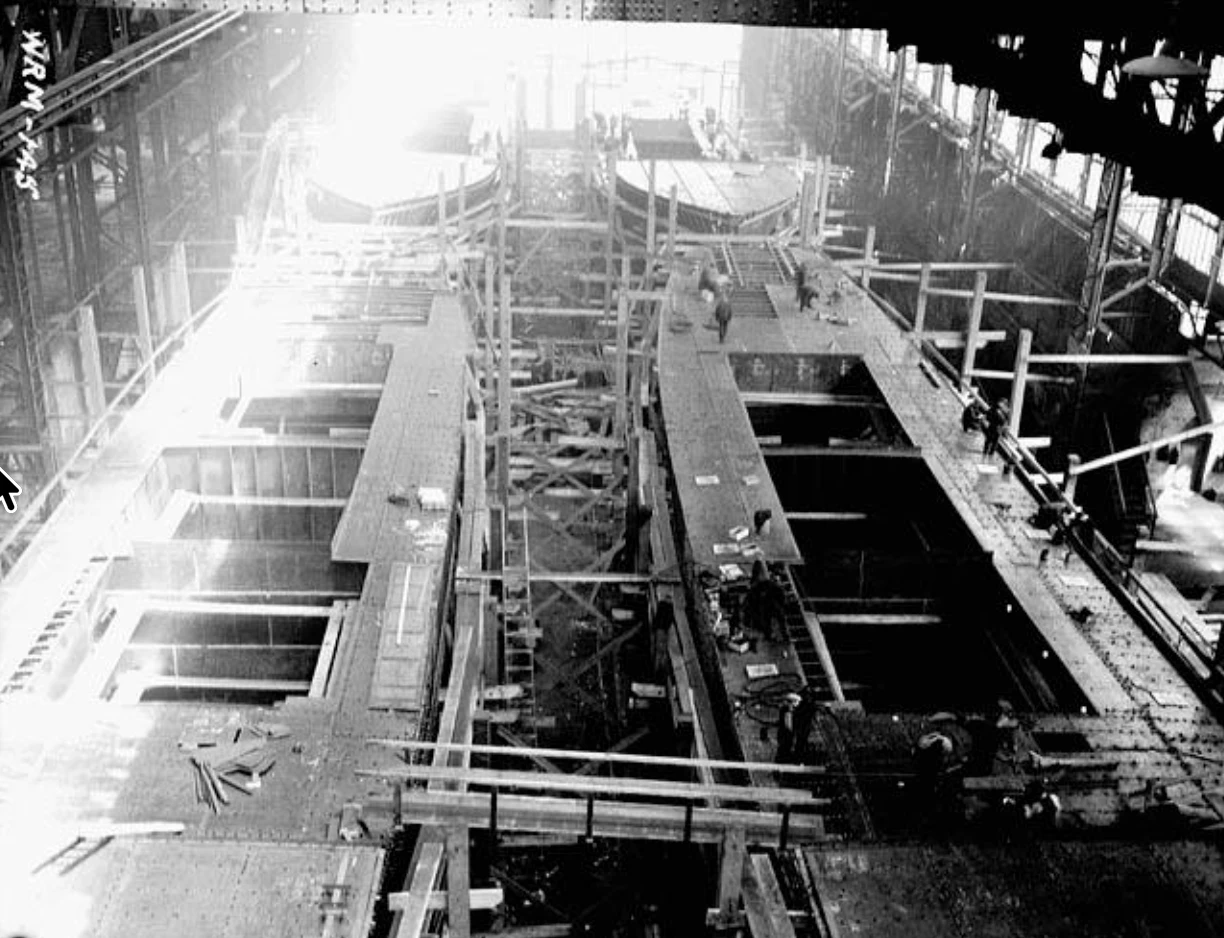
South Yard, Burrard Dry Dock Built on the south side of Burrard Inlet, Burrard Dry Dock’s south yard operated from 1941 to 1946. It concentrated on building hulls. Once launched, these were then sent to the north yard to be fitted out and finished. Like its sister yard, it had four berths. Visible in this photo are racks of steel plate ready for use and the rail tracks that brought in supplies. The steel supply was a major concern for Canadian shipbuilders. By March 1942, Wartime Merchant Shipping, the Crown corporation that organized the national production of merchant ships, needed 15,000 to 20,000 tons (13,605-18,140 t) of steel plate per month. (Each cargo ship required 10,000 pieces of steel.) Canadian manufacturers increased their output to avoid reliance on U.S. sources. The south yard closed down after the war, since there were insufficient contracts for Burrard Dry Dock to keep it going.
Sources Used
- [1-4] James Pritchard, A Bridge of Ships: Canadian Shipbuilding during the Second World War (Montreal and Kingston: McGill-Queen’s University Press, 2011).
- [5] John M. MacFarlane, “Yarrow Shipbuilders,” Nauticapedia, 2002, https://www.nauticapedia.ca/Articles/Articles_Yarrows.php.
- [6] Marc Montgomery, “September 3, 1939: The Horror Begins; Loss of SS Athenia,” Radio Canada International, September 3, 2014, https://www.rcinet.ca/en/2014/09/03/september-3-1939-the-maelstrom-begins-loss-of-ss-athenia/.
- [7] “HMCS Alberni – Wikipedia,” Wikipedia, https://en.wikipedia.org/wiki/HMCS_Alberni
- [8] Veterans Affairs Canada, “Chronology of the Second World War,” Veteran Affairs Canada, Government of Canada
- [9] Roger Sarty, “The Royal Canadian Navy and the Battle of the Atlantic, 1939–1945,” Canadian War Museum
- [10] Imperial War Museums, “The Battle of the Atlantic Explained,” Imperial War Museums
- [11] CPO1 (Ret’d) Pat Devenish, “The Sinking of SS Caribou,” Trident Newspaper, November 2, 2020
- [12] Jan Drent, “Labour and the Unions in a Wartime Essential Industry: Shipyard Workers in BC, 1939-1945,” The Northern Mariner / Le Marin du Nord 6, no. 4 (October 1996): 47–64.
- [13] Naval Museum of Manitoba, “Battle of the Atlantic,” Naval Museum of Manitoba
- [14] “Corvettes (K) Built in WWII,” last updated July 9, 2011
- [15] HMCS Waskesiu. Wikipedia.
- [16] Government of Canada, “The Battle of the Atlantic, 1939-1945”

